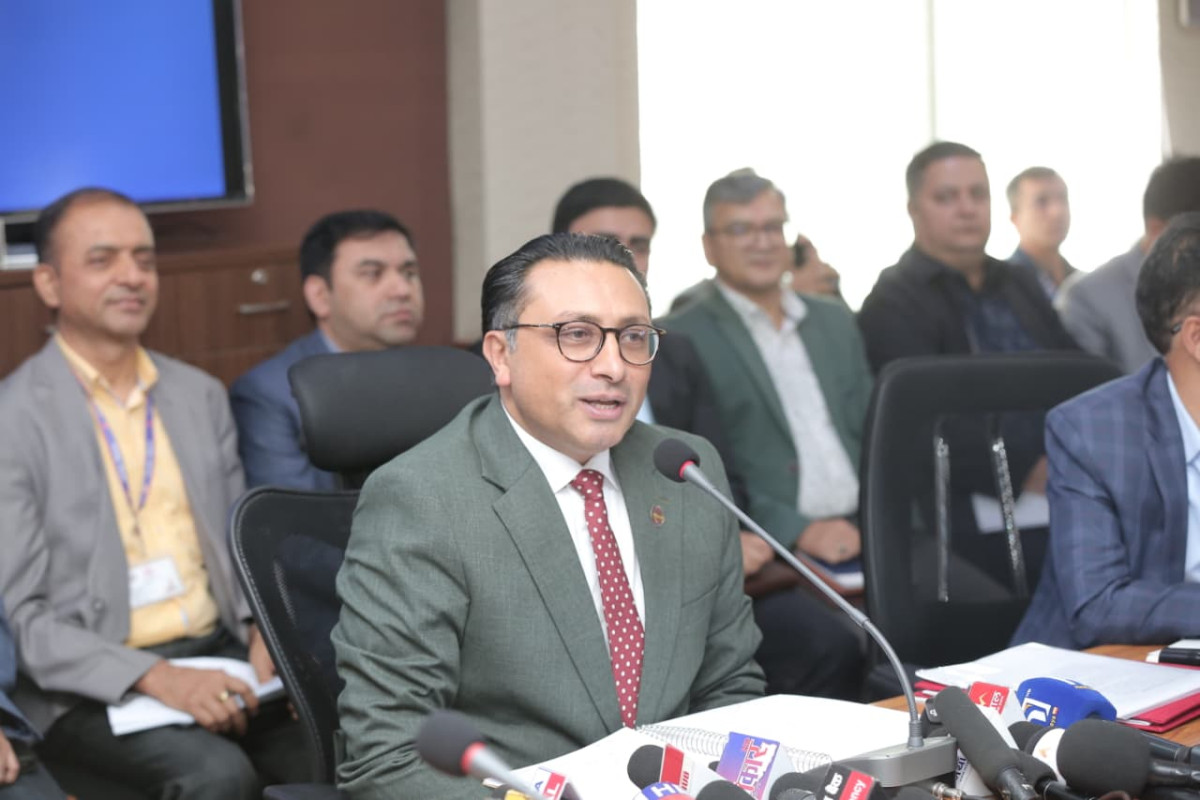
Speaking at a post-budget press conference organized by the Ministry of Finance on Sunday, Dr. Wagle argued that when evaluated against the actual size of the country’s economy, the budget is entirely realistic and well within the state’s capacity to implement.
"Market speculation had widespread rumors that the budget would soar to around Rs. 2,500 billion, but it actually came in at Rs. 2,124 billion," Dr. Wagle stated, countering claims that the fiscal plan is bloated.
Budget Size Relative to GDP
The Finance Minister emphasized that a budget should be analyzed in proportion to a nation's Gross Domestic Product (GDP) rather than looking at absolute numbers in isolation.
|
Economic Indicator
|
Value / Percentage
|
|
Total Budget Size
|
Rs. 2,124 billion
|
|
Projected GDP
|
Rs. 7,458 billion
|
|
Budget-to-GDP Ratio
|
28.5%
|
|
Current Public Debt
|
Rs. 2,975 billion (~43% of GDP)
|
Dr. Wagle pointed out that at 28.5% of the projected GDP, this budget is notably leaner than those of recent years, which peaked at up to 37% during post-earthquake reconstruction and pandemic relief efforts. He also rejected fears of an escalating debt crisis, noting that Nepal's debt accumulation has stabilized. For the upcoming fiscal year, the government plans to mobilize Rs. 657 billion in new loans while dedicating Rs. 318 billion to repay existing domestic and foreign debt obligations.
Addressing public confusion over civil servants' pay hikes, Dr. Wagle clarified that the total increase is a firm 21%. This consists of a 10% raise added directly to the base salary, combined with an additional 10% tied to upcoming performance-based civil service reforms.
Feasibility of 7% Economic Growth
The government has set an economic growth target of 7% for the fiscal year, a goal the Finance Minister deems highly achievable through a strategy aimed at revitalizing private sector confidence.
According to Gunakar Bhatta, Vice-Chairperson of the National Planning Commission, meeting this target will rely on:
- Agriculture sector growth of 3.5%
- Industrial sector growth of 10%
- Service sector growth of 7%
- Inflation capped at 6%, aided by declining international fuel prices.
Dr. Wagle reiterated that the state budget is meant to facilitate—not entirely control—the broader Rs. 7,000 billion national economy. By acting as a "big push" for core infrastructure like roads, electricity, and the legal system, the government aims to establish a strong regulatory environment that empowers private investors to drive major economic expansion.
Striking a Balance in Taxation
 On the tax front, Dr. Wagle explained a deliberate policy shift toward taxing consumption rather than income. For instance, while a new 5% VAT has been introduced on electricity, life will remain unchanged for low-income households. Users consuming under 50 units a month are exempt from the tax, while those using up to 150 units will only see a nominal monthly increase of about Rs. 24. Meanwhile, middle-income earners stand to benefit from income tax relief, including a 1% exemption on annual earnings up to Rs. 1 million.
Additionally, the Finance Minister confirmed that the capital gains tax on the stock market will remain a final tax, noting that a minor rate hike was implemented based on direct feedback from investors. Revenue generated from newly introduced health and equity taxes will be funneled directly into social welfare, including doubling the child nutrition allowance—creating an Rs. 8 billion annual liability—and upgrading community schools.
Extraordinary Measures for Implementation
To ensure this budget avoids the chronic under-spending traps of the past, where capital expenditure typically hovered around 25% by mid-March, the Ministry of Finance has introduced unprecedented structural reforms.
"Our government employees are highly capable of hitting these targets," Dr. Wagle asserted, guaranteeing that mid-term budget cuts would not be required this year.
To back this claim, ministries have been granted immediate execution authority starting just two days after the budget announcement. Furthermore, special provisions embedded in the Appropriation Bill will now allow the flexible reallocation of frozen funds from underutilized sectors directly into high-performing, resource-starved projects to ensure timely execution.