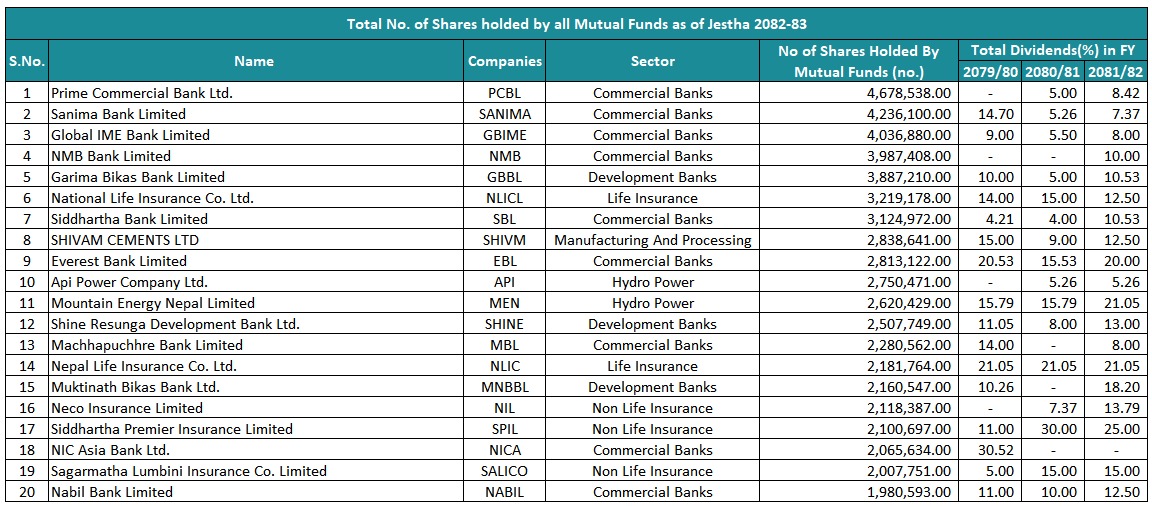
According to financial disclosure data compiled through May 2082/83, fund managers are concentrating capital in high-liquidity stocks that offer stable dividend payouts and robust corporate governance.
Out of the top five individual stocks held across mutual fund schemes, four belong to the commercial banking sector. Analysts note that these holdings allow fund managers to manage large trading volumes without creating significant price slippage in the secondary market.
Prime Commercial Bank (PCBL) leads as the single most held equity position, with mutual funds collectively holding 4,678,538 share units. Global IME Bank (GBIME) follows closely with 4,436,880 units, while Sanima Bank (SANIMA) occupies the third position among banking entities at 4,236,100 units. Both NMB Bank and Siddhibank (SBL) also remain primary banking allocations within institutional portfolios.
While commercial banks remain the bedrock of institutional investments, mutual funds have strategically expanded into development banks, insurance, manufacturing, and hydropower:
-
Development Banks: Garima Bikas Bank (GBBL) stands out as the most preferred non-commercial banking institution, holding 3,887,210 units and ranking 5th overall across all sectors.
-
Insurance Sector: Long-term institutional capital is heavily concentrated in National Life Insurance (holding over 3.21 million units) and Nepal Life Insurance.
-
Manufacturing & Energy: Shivam Cements (SHIVM) remains the sole major industrial manufacturing stock favoured by fund managers with 2.83 million shares. In energy, Api Power and Mountain Energy Nepal hold the highest portfolio share among power producers.
Stock market analysts point out that mutual funds operate under strict mandates to balance risk against return. Commercial banks and established insurance providers provide the regular dividend yields necessary to distribute dividends to unit holders. Furthermore, as mutual funds buy and sell in multi-million-rupee tranches, the deep liquidity and large float of commercial bank shares remain essential for smooth portfolio execution.