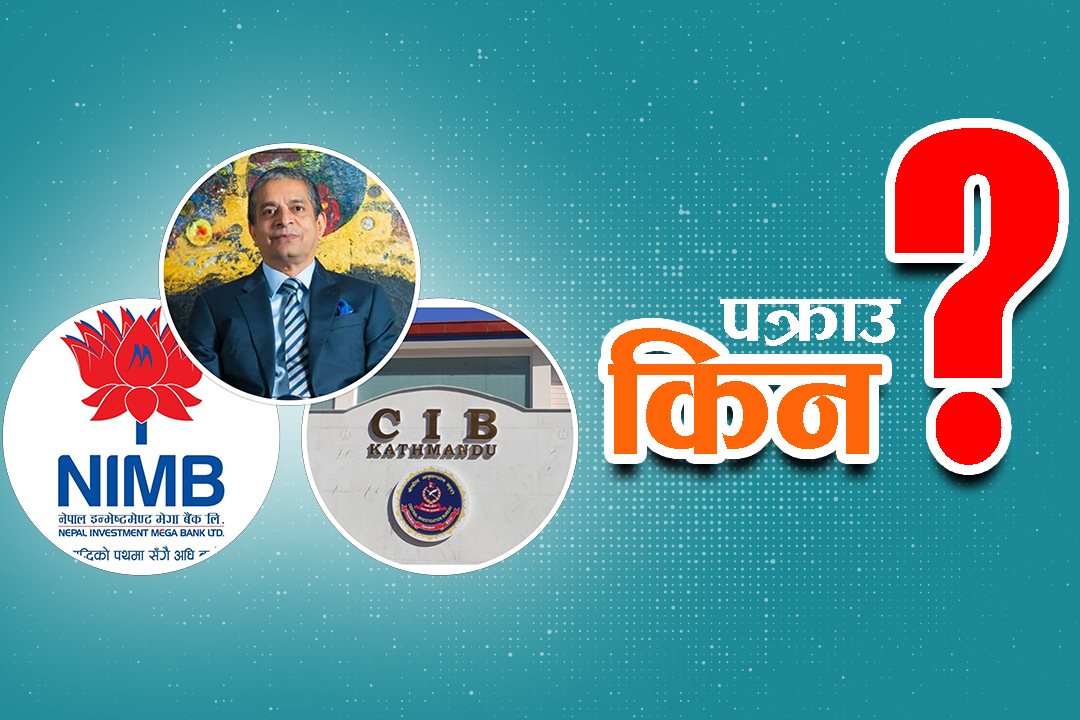
After the arrest of Jyoti Prakash Pandey, the Chief Executive Officer (CEO) of Nepal Investment Mega Bank (NIMB), by the Central Investigation Bureau (CIB) of Nepal Police, it has sparked a serious debate in the financial sector. The case is related to loan worth billions taken by Smart Telecom from the bank and the auction process of the collateral kept as security of the loan. The bank had auctioned towers and other technical equipment of Smart Telecom to recover its loan of Rs 4.6 billion. The auction has been tagged as "fraud" and illegal sale of "government property" by the police and arrested Pandey. This incident has brought the huge contradiction between the claim of protecting the assets of the state, on the one hand, and on the other hand, the legitimate debt recovery process done by the bank to protect the depositors' money to the forefront.
Former banker Bhuwan Dahal has a very clear and professional view on this sensitive issue. Dahal expressed surprise over the arrest of CEO Pandey and raised the issue of international banking practice. According to Dahal, it is a common practice around the world that if any property is created by investing the bank's money, then the bank has the first right to it. He says, "It is an international practice that if any wealth is created by borrowing the money of the bank, then the bank has the first claim on it. In such a situation, there is no point of being arrested, it is the job of the bank. "
Emphasizing the business ethics and procedures of the bank, Dahal further clarified that if there are any other personal issues or aspects of the investigation, it is a different matter, but arresting the CEO of a bank on criminal charges on the basis of auctioning the collateral is beyond the banking logic. "Banks have the right to auction property, I don't understand what the police have written," he says. The property/wealth created by the bank's money, is the property of the bank, until the loan is repaid. Dahal's argument shows that no bank will dare to invest in big projects in the coming days while criminalizing the bank's efforts to secure its investment.
Similarly, the attitude of the regulatory body, Nepal Rastra Bank (NRB), is even more vague and serious in this case. Guru Prasad Poudel, spokesperson of the NRB, has talked about the main resources of the banks and their security. Stating that he respects the investigation process of the police, Poudel stressed that the main concern of the NRB should be the safety of the depositors' money. He said, "The concern of NRB should be that, the source of the loan issued by the banks and financial institutions (BFIs), is their deposits. It is the responsibility of NRB to protect deposits. "
According to Poudel, the banks may fail to repay the depositors' money if the loan is not repaid. He further says, "The collateral of the borrower can be a movable collateral or a fixed mortgage when BFIs issue loans. In the event of non-payment of the loan, the lender should be able to recover the loan in a procedural manner in case of non-payment, it should be allowed to sell-out. "
Poudel's statement has restored one of the basic principles of the banking system — the right to recover debt. He made it clear that if banks are unable to repay their loans by procedural mortgage auctions, they may fail to return the money to depositors, which could lead to financial crisis. "If this is not done, the BFIs may fail to return the depositors' money. He, however, maintained that other state agencies should respect investigations for any reason. However, his main emphasis seems to be that the first priority should be given to banks to claim on collateral to protect their investments.
At the root of this dispute is the 'ownership' battle created after the license of Smart Telecom was revoked. After the government revoked the license of Smart Telecom in Baisakh 2080, the CIB claims that all its structures belong to the government. However, the Telecommunications Act 2053 does not make provision that in the case of companies with domestic investment, the property automatically belongs to the government when the license expires. In such a situation, it is not only the legal right but also the business obligation of the bank to auction the equipment secured for its loan. Clause 57 of the Bank and Financial Institutions Act (BAFIA) 2073 has given extraordinary powers to the bank. It states that the bank can recover its principal and interest by auctioning the collateral "irrespective of what is written in the prevailing law". As Bhuwan Dahal has said, it seems justified that the bank should claim its right to the tower built with the bank's money before the government.
The arrest of CEO Pandey has created an atmosphere of fear in the banking sector. What will be the future of the banking business in Nepal if a bank publishes a 35-day and 15-day notice in the national daily, informs everyone and conducts the auction in a transparent manner? This question is on every banker's mind right now. As Bhuwan Dahal indicated, this is a procedural work and if there is a mistake in the process, there is room to correct it. But it is not fair to arrest a leader for a business decision made without bad intentions. Spokesperson Poudel said that the security of depositors is the duty of the bank and the state should support the steps taken by the bank against companies like Smart Telecom that do not repay the loans.
It is ironic that Smart Telecom is trying to escape not repaying the loan of more than Rs 4 billion to the bank in the disguise of government property and the state agencies blame the bank for this. If the government claims that these properties belong to it, then according to Poudel, the government should also bear the burden of the debt incurred in the creation of those assets. The tendency to own property but not repay loans can bankrupt a country's economy. Stopping a bank that runs on depositors' money when it seeks its safety is ultimately playing with the savings of the common man. Both Bhuvan Dahal and Guru Prasad Poudel conclude that the bank's first duty is to ensure the return of depositors' money, for which mortgage auction is an essential legal tool.
Ultimately, the case has badly exposed Nepal's lack of legal clarity and coordination between agencies. On the one hand, there is the BAFIA, which gives the bank the right to recover the loan. On the other hand, there are telecommunications regulations that give ownership to the government. But, as Guru Prasad Poudel said, the security of deposits is the foundation of the financial system. If bank officials are arrested destroying this very foundation, tomorrow people will be afraid to put money in banks and banks will stop investing. Before this situation arises, the state must properly define assets and liabilities. The arrest of CEO Jyoti Prakash Pandey is not just an individual's issue, it is a fight for Nepal's banking autonomy and depositors' safety.
As Bhuwan Dahal has said, it would be wise to correct this 'surprising' step and create a business environment. State agencies should not sacrifice the legitimate rights of banks and the interests of depositors in conducting investigations. Only proper justice and adherence to the law can save the economy from crisis and help maintain fiscal good governance. It is bank’s business duty to own the equipment that the borrowed money buys. It should not be criminalized. The settlement of this case will determine the future direction of banking and investment in Nepal.
The state needs to take a serious look at its own laws before calling the bank's efforts to protect depositors' hard-earned money a "fraud". To overcome this confusion in the banking sector, the NRB and the government should soon come up with a common and clear approach. So that in the future, no banker will have to fear going to jail for performing his duty. No one should lose sight of the fact that weakening the banks, which are the economic backbone of the country, will ultimately weaken the state. Therefore, it is the need of the hour to take a decision in the case of Pandey's arrest and the auction of Smart Telecom keeping in mind the spirit of law and banking reality. The security of deposits and the recovery of legitimate loans are the first prerequisites for a strong economy.